

The Parish Church of Villa Ottone: History and Faith in Val Pusteria
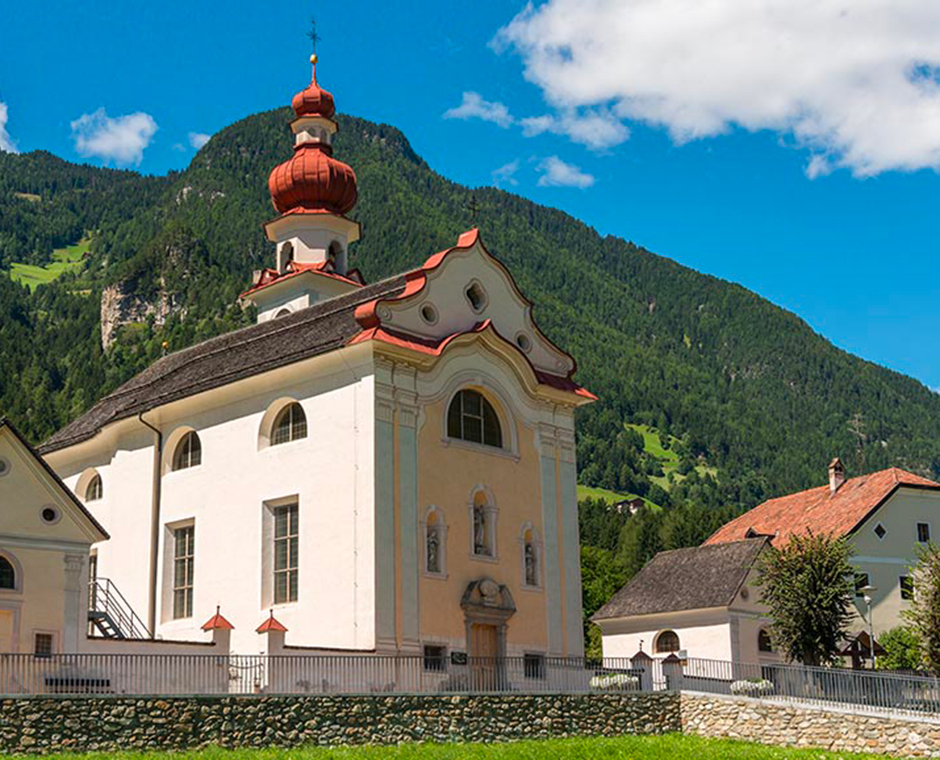
In the heart of Val Pusteria, the Parish Church of Villa Ottone stands as one of the most significant examples of architectural and spiritual transformation in South Tyrol. From its origins in the 10th century to its Baroque reconstruction, this church preserves a fascinating history rich in art and devotion.
The Earliest Traces and the Romanesque Style
The first document mentioning the church dates back to 970, while between 1174 and 1178 Bishop Richter officially consecrated it, dedicating it to Saint Margaret, the patron saint invoked against storms and adverse weather. Originally, the church was built in the Romanesque style, with simple and solid forms.
The Work of the Master of Villa Ottone
After the mid-15th century, the church was completely renovated in Gothic style by an artist known as the Master of Villa Ottone, whose identity remains shrouded in mystery. This artist is considered one of the most important interpreters of Alpine Gothic and is thought to have been the teacher of Michael Pacher, the brilliant Tyrolean painter and sculptor of the late Gothic period. The wooden altarpiece he carved was a true masterpiece, though unfortunately it has not survived.
Destruction and Rebirth in Baroque Style
In 1772, lightning struck the church, destroying it completely. It was then decided to rebuild it entirely in Baroque style, with larger dimensions than before. The works were directed by the engineer Gasser, a native of Villa Ottone who was also active in Brunico.
In 1788, by decree of Emperor Joseph II, Villa Ottone obtained a resident curate—the first being Josef von Wenzl. Only in 1891 was the chaplain elevated to the status of parish priest, and from that moment the church officially became a parish church.
A Treasure of Sacred Art
Inside the church, visitors can admire 19th-century altars, ceiling frescoes, and a Via Crucis painted by Franz Zeiler. On the main altar stand statues of Saint Joachim and Saint Anne, while the altarpiece is an elegant copy of the one in the Church of Saint Agnes in Bressanone. The ensemble conveys a sense of harmony and devotion, telling a story of centuries of faith and beauty.