

Castle Gardena: The Castle of Fishing
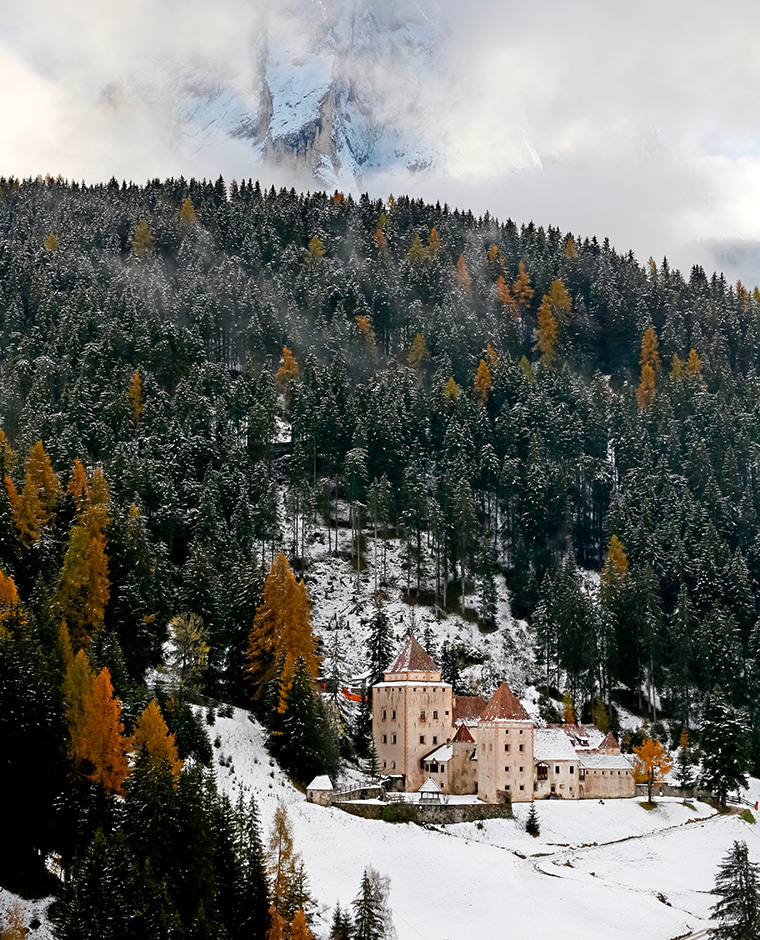
Amid the forests and majestic peaks of Val Gardena, perched on a hill overlooking the Rio Gardena, stands the imposing Castle Gardena. Often also referred to as the “Castle of Fishing”, this fascinating building is one of the most remarkable historical landmarks between the villages of Selva and Santa Cristina.
A Renaissance residence with a medieval soul
The castle was commissioned in 1622 by Engelhard Dietrich von Wolkenstein-Trostburg, a member of one of Tyrol’s most influential noble families, and completed in 1641.
Originally conceived as a summer and hunting residence, the manor impresses with its massive and fortified architecture, reminiscent of medieval castles, despite being a structure of the Renaissance era.
The alternative name “Castle of Fishing” comes from the tradition of artificial ponds that once surrounded the estate, used for fishing by the noble owners. These ponds, now vanished, added both elegance and a recreational function to the residence.
Its public role and history
For more than a century, Castle Gardena also played an important institutional role: until the late 18th century, it housed the Selva court, making it a point of reference for the entire valley. Over time, however, social changes led to the building’s abandonment.
In 1826, the noble Wolkenstein-Trostburg family decided to auction off many of the estate’s assets, including a collection of hunting weapons now considered of great historical value. Shortly after, in 1841, the castle was donated to the municipalities of Selva and Santa Cristina to serve as a shelter for the poor and elderly.
In 1926, Castle Gardena was purchased by Baron Franchetti of Venice, who restored it and made it his summer residence. The castle still belongs to the Baron’s family today and is therefore not open to the public.
Although not accessible, Castle Gardena continues to exert a subtle yet powerful charm on those who admire it from below, nestled among the woods and slopes of Val Gardena. A silent yet eloquent symbol, reminding us how vividly the past can still speak.