

The Dolomites: A World Heritage Site of Geology, Beauty, and Culture
The Dolomites are not just mountains — they are a universal symbol of natural beauty, history, and Alpine culture. They extend across an impressive area of 142,000 hectares between the provinces of Bolzano, Trento, Belluno, Udine, and Pordenone, with an additional 90,000 hectares of “buffer zone” established to protect the central areas from invasive development. Yet, these figures alone cannot capture the profound spirit of a land that enchants, moves, and speaks to the heart of those who traverse it.
The Dolomites and the UNESCO Recognition
The name “Dolomites” was born in 1791 thanks to the studies of the French naturalist Déodat de Dolomieu, who first analyzed the peculiar geological composition of dolomite rock, formed by a double carbonate of calcium and magnesium. Scholars such as Giovanni Arduino and Alexander von Humboldt also studied its characteristics, helping to spread the term. The name was officially adopted only after World War I, when the entire territory was annexed to the Kingdom of Italy.
On June 26, 2009, UNESCO officially recognized the Dolomites as a World Natural Heritage Site for their unique geological, botanical, and landscape features. During the Seville congress, the IUCN (International Union for Conservation of Nature) described the Dolomites as “one of the most beautiful mountain landscapes in the world”, highlighting their exceptional value even without the highest peaks or largest glaciers. From that moment on, under the emotional gaze of the local authorities who had long hoped for such recognition, the Dolomites were declared a priceless natural treasure.

The Pale Mountains and the Legend of the Enrosadira
Among the many legends surrounding these mountains, one of the most enchanting tells the origin of the name “Pale Mountains”. The story features two lovers forced to live apart: he had to remain in the shaded forests to avoid blindness, while she could not survive without light. A gnome, moved by their fate, made the mountains glow so the lovers could reunite. From then on, the Dolomites became the Pale Mountains.
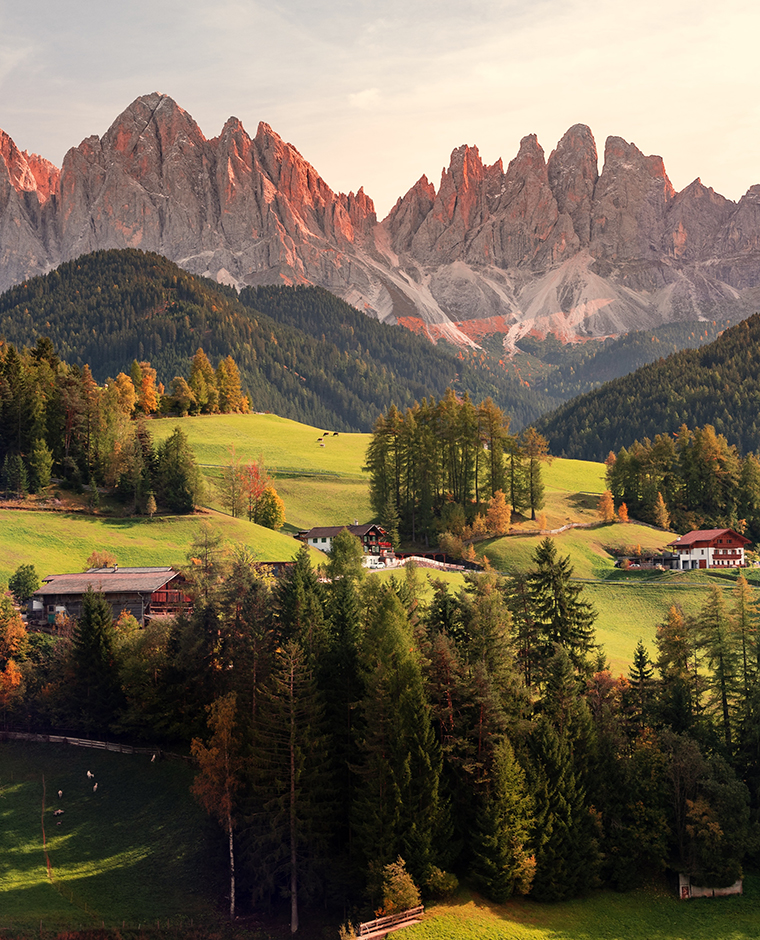
The legend intertwines with a remarkable natural phenomenon: the enrosadira — from the Ladin term meaning “to turn pink” — which describes the pink and violet hues that tint the Dolomite peaks at sunset. This unique spectacle is made possible by the mineral composition of dolomite, which reflects sunlight in a special way. A sunset in the Dolomites is never just a sunset: it’s pure poetry.
The Dolomites as Artistic Inspiration
The Dolomites have inspired poets, artists, and architects throughout history. Dino Buzzati, writer and painter, found in these mountains the form that inspired his reinterpretation of the Milan Cathedral, while the Swiss architect Le Corbusier described them as “the most beautiful natural architecture in the world.” A landscape that stirs the imagination and evokes the sublime — capable of turning a mountain into a living work of art.
Active Protection: Natural Parks and Sustainable Tourism
Today, the Dolomites are protected by numerous natural parks that safeguard both the environment and local culture. This is not just about landscape preservation, but a comprehensive project that integrates sustainable development, environmental education, and territorial promotion.
A virtuous example is the Dolomiti Superski, the world’s largest ski carousel, connecting 12 ski areas and allowing enthusiasts to experience winter in full harmony with nature. The idea originated from Anglo-Saxon and Austro-Hungarian visitors who, as early as the 19th century, had grasped the tourism potential of the Dolomite slopes.
The Dolomites Today: Between Roots and the Future
Few other places in the world demonstrate such harmonious coexistence between human activity and nature. The Dolomites are a shining example of how natural beauty can be protected and enhanced without being compromised. Their history, legends, landscapes, art, and Ladin culture continue to attract travelers from across the globe.
Visiting the Dolomites means stepping into a millennia-old story, where every peak holds a myth, every valley a tale, and every sunset an emotion. So — are you ready to become part of it?