


The Hill of Sant’Ippolito: A Thousand Years of History and Breathtaking Views
In South Tyrol there are places that tell their story not only through monuments, but also through the landscape itself. One of these is the Hill of Sant’Ippolito, rising at an altitude of 758 metres above Tesimo and Prissiano in the Burgraviato area. Known as the “Royal Balcony of the Burgraviato” for the extraordinary panorama it offers, this height has for centuries been a privileged vantage point over the Adige Valley and the surrounding mountains.
One of the Most Important Prehistoric Sites in South Tyrol
The Hill of Sant’Ippolito is also one of the region’s most thoroughly studied prehistoric sites. Archaeological excavations have unearthed finds from the Late Stone Age, the Bronze Age and the Iron Age, clear evidence of human presence since the most ancient times.
According to some scholars, it was on this very hill that a Lombard castle known as Tesana was built around 590 AD, attesting to the site’s strategic importance even in the Middle Ages.
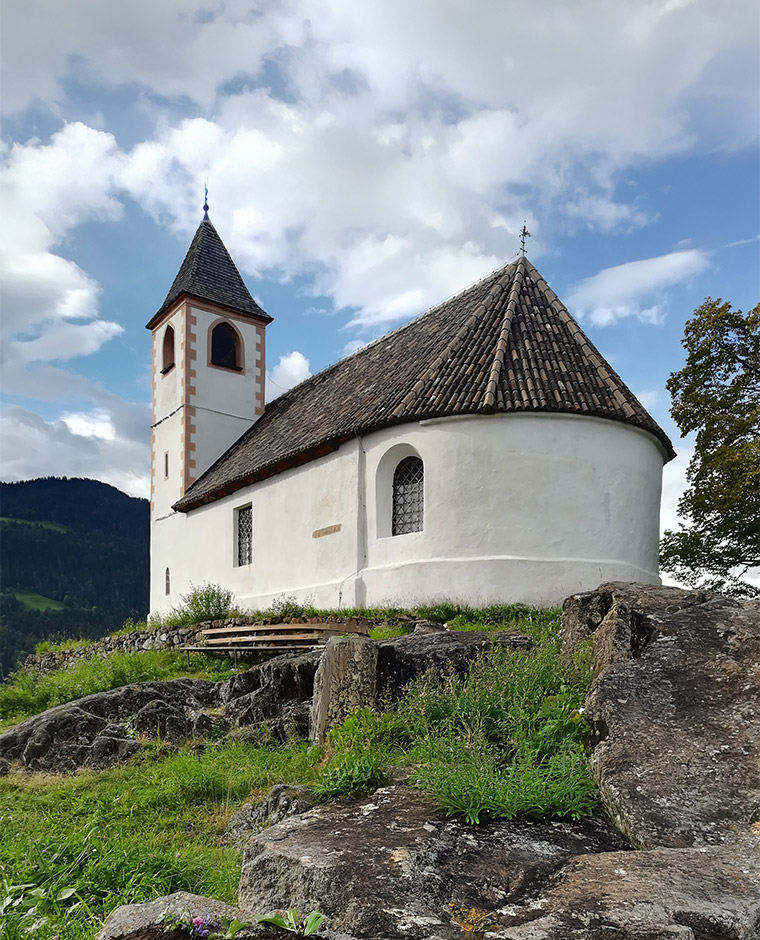
The Church of Sant’Ippolito: Between Romanesque and Gothic
In 1340 the Church of Sant’Ippolito was built—a small gem combining Romanesque and Gothic architectural elements. The bell tower houses a bell dated 1556. Inside the little church, visitors can admire beautifully preserved frescoes that make the visit especially evocative.
Despite its beauty and historical significance, the church never had a resident priest, as it was too close to the Parish of Tisana. From 1566 onwards, a sacristan was instead appointed, whose main duty was to ring the bells during thunderstorms—a practice once believed to ward off storms.
Lightning and Fate: The Dark Legend of the Hill
Due to its exposed position, the hill is frequently struck by lightning. It is no coincidence that in the parish’s book of the deceased there are six recorded cases of deaths caused by lightning, all occurring while the sacristan was carrying out his duty. A tragic curiosity, yet one that illustrates how deeply faith, nature, and daily life were intertwined in Alpine culture of the past.
A Place Where History and Nature Meet
The Hill of Sant’Ippolito is not only an important archaeological site, but also a perfect destination for those who love scenic walks and the discovery of South Tyrol’s lesser-known places. Surrounded by greenery, wrapped in silence, and steeped in centuries of history, this hill is an unmissable stop for lovers of archaeology, spirituality, and breathtaking landscapes.